Showing posts with label Honda. Show all posts

Wednesday, June 29, 2011

2012 Honda CRV

 
Honda is an automotive company based mostly in Japan and encompasses a smart name for many years. Such name was once more, proven when in 2011, they issued a 2012 Honda CRV unleash date, a CR-V vehicle-type that has been common among its users. Thankfully, the vehicle CR-V conjointly encompasses a stylish style, even appearance to a small degree flamboyant. With a black body paint that is exposed in each a part of his body, this vehicle actually appearance manly.
When the Honda set to issue 2012 Honda CRV Honda unleash date, perhaps there are plenty of individuals are interested in the power of this new automobile. Well, this automobile is supplied with 4-cylinder engine with capability of two.4 liters, that is claimed to provide up to one hundred eighty horsepower. With specs like these, of course, this automobile encompasses a fairly massive acceleration speed. Moreover, this CRV has additional blessings compared with alternative cars released by completely different corporations.
 

However, after they issued a 2012 Honda CRV unleash date, some folks might not feel snug with the value of this automobile. As you will grasp, this automobile is assessed underneath the high-priced CRV kind, that one automobile is sold at a spread worth, however usually ranges from $ twenty three,000 up to $ thirty,100. Certainly, it’s quantity of worth that has got to be quite expensive for many folks.
The new Honda CR-V is one of the quick trading sport utility vehicles.The 2012 Honda CR-V is a small sports utility vehicle that can seat 5 passengers. It is powered by a four-cylinder 2.4 Liter engine that does 166 horsepower. It is equipped with a five speed automatic transmission, achieving a speed of 60 miles per hour in 9.5 seconds. The fuel economy ratings of the CR-V are 20 miles per gallon on city streets and 27 miles per gallon on the highway.

Tuesday, June 28, 2011

Honda Insight Hybrid racer banned - it's too fast

Modified, previous-generation Honda Insight has blown away a field of conventional rally cars.
Technically, the car you see here is a hybrid capable of some pretty impressive consumption, yet it's been banned from rallying for being too fast.

Yes, the world's greenest rally car has been kicked out of its championship because it's too quick.

The petrol-electric (previous shape) Honda Insight hybrid, which competes in the Formula 1000 rally championship in the UK, has been asked to withdraw following concerns from rival competitors that it has an unfair advantage, after dominating the 2011 series with two wins and a second place from the first three rounds.

The car, which uses a tuned petrol-electric hybrid system to give it more power and better fuel efficiency, has been developed by the Oaktec team from Lancaster over a six-year period using the low emission Honda car as a base.

The developments of the green technology have been so successful that the eco car, which can return an amazing 2.4 litres per 100km when driven slowly, has blown away a field of conventional rally cars to gain a 19 point championship lead after just three rallies.

The championship organisers phoned the Oaktec team to request that they stand down from the series and compete the car in a higher class to appease rival competitors. The team has agreed to the demand and will now look to race in other classes.

Oaktec boss Paul Andrews commented: “It was a bit of a shock when I got the call as after six years of hard work we finally had our chance for a bit of glory. But I fully understand the perspective of the organisers and their wish not to spoil the sport for the other drivers.”

Source;
http://www.iol.co.za/motoring/motorsport/hybrid-racer-banned-it-s-too-fast-1.1090243

Honda: Operating profit forecast not conservative

TOKYO: Honda Motor Co's annual operating profit forecast is not conservative given yen strength and rising raw materials prices, the automaker's chief financial officer said on Tuesday.

"I don't think assuming 80 yen to the dollar is conservative at all," Fumihiko Ike told a small group of reporters. "The same goes for raw material prices," he said.

Japan's No.3 automaker this month forecast a worse-than-expected 65 per cent fall in annual operating profit to 200 billion yen ($2.49 billion) for the year to March 2012 and projected a 6 per cent drop in global car sales to 3.3 million vehicles.

Many analysts consider its guidance overly conservative.

Source;
http://economictimes.indiatimes.com/news/international-business/honda-operating-profit-forecast-not-conservative/articleshow/9021763.cms

Monday, June 27, 2011

Car and Driver Mag: 2012 Honda Pilot Spy Photos - Future Cars

The cyborg grille is gone, but the rest of the Pilot remains mostly unchanged.
BY JUSTIN BERKOWITZ, PHOTOGRAPHY BY BRENDA PRIDDY & CO. AND THE MANUFACTURER June 2011

The Honda Pilot isn’t as weird as a Citroën, nor is it as thrilling as a BMW M3. In spite of this—or perhaps because of it—Honda’s eight-passenger crossover SUV sells in substantial numbers, impressive work for a car that debuted in its second generation for 2008. (It joined our long-term test fleet soon after.) To keep shoppers interested, though, Honda’s making some tweaks for 2012, and our spy shooters have caught one of the face-lifted Pilots running around.


The most notable difference is the change in the grille. The current car’s cyborg-like front fascia was a bit of a styling risk from such a conservative company, and while it probably didn’t hurt sales, it didn’t win loads of fans either. It’s immediately apparent from these images that the flat grille will disappear, to be replaced with a three-slat insert. Tape on the rear bumper suggests some resurfacing there as well. Otherwise, the Pilot’s exterior remains mostly the same as it has been; it’s an inoffensive design and still looks fresh enough to satisfy families in the showroom.


Mechanically, the alterations to the Pilot will most likely be evolutionary. Honda has been upgrading most of its models’ five-speed automatic transmissions with six-ratio units; you can expect the Pilot to join the six-speed in-crowd. Between the new gearbox and—perhaps—some finessing of the engine’s greasy bits, we wouldn’t be surprised to see the Pilot gain an extra mile per gallon or two. For the folks who put cartoonish drawings of themselves and their pets on the rear window, this will be pleasant news.


We expect Honda to unveil the face-lifted Pilot sometime this fall, either at November’s Los Angeles auto show or at a less-full-of-fanfare venue. It’ll be a busy fall for the company’s crossover division, as we’re also expecting an all-new CR-V. We’ll bring you full info on both cars when it arrives.


Source;

Report: The two 'most American' cars are Japanese

The two most American cars aren't, well, American, according to a new ranking by our friends at Cars.com. For the third straight year, Toyota Camry, a product of Japan's largest automaker, is the "most American car," as determined by Cars.com formula. Honda Accord, the flagship of Japan's second largest automaker, is second.

The highest car on Cars.com annual ranking from a Detroit Big 3 maker is General Motors' Chevrolet Malibu.

Cars.com's annual American-Made Index ranks the most-American vehicles based on percentage of their parts that are made domestically, where they are assembled and how many are sold to U.S. buyers.

Both Camry and Accord are made with 80% of their parts coming from the USA. And most are assembled in the U.S. Camrys are made in Georgetown, Ky., and Lafayette, Ind.

The Ford Explorer comes to the list, reborn as a crossover, with a higher percentage of domestic parts, 85%, than a Camry or Accord and is made in a Chicago factory. But it doesn't sell in as great a numbers as they, meaning also that it probably results in fewer American factory jobs.

"In today's global economy, there's not an easy way to determine just how American a car is," said Patrick Olsen, Cars.com editor in chief. "Most cars built in the U.S., for example, are assembled using at least some parts that come from somewhere else. Additionally, many U.S. automakers assemble vehicles in Canada and Mexico, while foreign automakers have opened plants on U.S. soil. Our index is another resource that car buyers can use to help guide their purchase decision."

Besides Camry, Toyota also has the Tundra (No. 9) and the Sienna (No. 6) on the list. GM also has three vehicles on the list -- the first time since 2009. In addition to Malibu, they are Chevy Traverse (No. 8) and the GMC Acadia (No. 10). Honda held two spots in the top 10, while Ford and Chrysler each held one.

"Despite the disaster in Japan, and General Motors usurping Toyota as the world's largest automaker, we're not surprised to see the Camry in the No. 1 position again," said Olsen. "The Camry remains an incredibly popular vehicle, and higher total sales require a higher number of U.S. factory workers and a larger number of U.S. suppliers – all of which contribute to Toyota's ranking."

Here's the list of the top 2011 model-year vehicles on Cars.com's list, and their percentage of domestic parts:

Toyota Camry: 80%.
Honda Accord: 80%.
Chevrolet Malibu: 75%.
Ford Explorer: 85%.
Honda Odyssey: 75%.
Toyota Sienna: 75%.
Jeep Wrangler: 78% for 2-door, 79% for 4-door.
Chevrolet Traverse: 75%.
Toyota Tundra: 80%.
GMC Acadia: 75%.

Source;
http://content.usatoday.com/communities/driveon/post/2011/06/ranking-the-two-most-american-cars-are-from-japanese-makers/1

2012 Honda CRV website up and running

Shrawan Raja of the sites below was kind enough to send a 'heads up' to the new 2012 Honda CRV teaser site up and running here http://automobiles.honda.com/2012-cr-v/

http://indianautosblog.com
http://indianmotosblog.com
http://steeringnews.com
This is straight from Shrawan's site;

Here’s what the website says -

With a new design—both inside and out, new features and new possibilities, the 2012 CR-V will set a new standard for the class. As a top-selling crossover for over five years, expectations for the 2012 CR-V are high and we’re confident they will not only be met, but exceeded. Much more will be revealed over the next several months so be sure to sign up on this page to receive updates.

The new CR-V is a crucial model for Honda in India as the 20-30 lakh rupee crossover/SUV space is prone to a lot of tussling. The Chevrolet Captiva, BMW X1, Toyota Fortuner and the Renault Koleos are very desirable cars and feature-packed and stylish enough to take away limelight away from the Honda. The lack of a diesel engine is hurting its sales in India. In America however this won’t matter as the market share of diesel cars is not considerable.
It is said that the new CR-V (codename 2WS) will arrive with a 4-cylinder gasoline engine producing 180 – 220 horsepower. A hybrid variant is reportedly another development exclusive to the Japanese and American markets

The incoming model according to reports online will be marginally shorter (4,535mm x 1,820mm x 1,685mm as opposed to the current model’s 4,575mm x 1,820mm x 1,680mm (L*W*H respectively) ) and slightly more fuel economical.

Source:
http://indianautosblog.com/2011/06/2012-honda-cr-v-microsite-live#ixzz1QTwURi00

Friday, June 24, 2011

2012 - 2013 Euro Honda Civic's

Here are a couple of pic's of what may be in store for UK Honda, a Hatchback (like the 2002-2005 Civic SiR that we saw here) and the sedan version of the Civic?!?

Thanks for pointing this out Ron!

Source (via Ron);
http://visions-autos.sport24.com

Honda is the brand with fewest warranty claims, study says

UK warranty specialist MB&G states that the companies that filed the fewest number of claims for the past year are those from Japan and Korea. Honda has received the top spot in this study. MB&G noted that as drivers have decided to keep the cars until they’re in their fourth years or even up to six years, there are some drivers who will be surprised with the type of maintenance costs that they’d have to incur.


Kevin Pearce, a director of MB&G, said that modern day cars are “reliable” but that errors are more common in the fourth or fifth years and if “the mileage reaches 70-100,000 miles.” He explained further that the cars feature plenty of electronic equipment that controls the engine management automatic gearbox and a small software error can often create issues.


Of course, there’s wear and tear that have to be considered. MB&G says that the average age and mileage of cars being is increasing, but generally, the corporate/SME market doesn’t like to go beyond the warranties. Pearce said that each year, tens of thousands of warranties are being processed. The average age of those cars are also increasing quite significantly. Pearce added that for now, there are more drivers who would drive around, thinking about purchasing a warranty for “extra peace of mind.”


Source;

Honda Greensburg plant gets survey's highest award

Honda Greensburg was named one of the world's best car assembly plants

.J.D. Power and Associates, a research firm that hands out an annual prize likened to the Academy Awards of vehicle manufacturing, on Thursday singled out the southeast Indiana factory.

Honda Greensburg received the researcher's highest rating, the Platinum Plant Quality award.The Greensburg plant, which assembles the Civic car, scored 24 problems per 100 vehicles, compared with an industry average of 107 problems per 100 vehicles.

"It's a real feather in the cap for a plant that is that new," said Ed Miller, American Honda Motor Co. senior manager for corporate affairs.

Honda opened the plant in 2008 after selecting 900 workers from about 30,000 job applications. Honda is now recruiting a second shift of about 1,000 workers to start late this year.

Honda plants differ from Toyota's and General Motors' by relying slightly less on automation and more on hands-on effort on the assembly line.

To obtain the results, J.D. Power surveyed 73,000 cars and trucks of all makes in the hands of buyers. The survey covers initial problems detected within 90 days of purchase of model year 2011vehicles.

Greensburg was tied for the Platinum award by Toyota's Lexus RX assembly line at Cambridge, Ontario, and Toyota Kyushu 2 in Japan, which produces the Lexus ES, IS and RX. Each plant scored 24 defects per 100 vehicles."

These results are an important demonstration of our focus on the customer and the tireless efforts put forth by Honda associates throughout our organization -- in R&D, in manufacturing and in sales -- toreflect the voice of our customers and to exceed their high expectations of Honda and Acura," Tetsuo Iwamura, chief executive of American Honda Motor Co., said in a statement.

Source;
http://www.indystar.com/article/20110624/BUSINESS/106240345/Honda-Greensburg-plant-gets-survey-s-highest-award

Thursday, June 23, 2011

Lexus, Honda top J.D. Power Initial Quality Survey, Ford plummets

Despite being caught in the undertow of Toyota's recall and safety issues last year, Lexis tops J.D. Power and Associates' Initial Quality Study (IQS) as the best brand in the survey being released today. Even better, Lexus' flagship LS sedan had the fewest problems of any vehicle in the first 90 days of ownership.

Meanwhile Ford, which was fifth last year and the only mass-market brand in the top five, fell to 23rd this year. It had 116 problems per 100 vehicles,up from 93 last year and worse than the industry average of 107 owner-reported problems. Its Lincoln brand dropped from No. 8 to 17 this year, with 111 problems.

Power attributed Ford results partly to two specific issues about which owners have complained: complicated communications and other controls and a dual-clutch automatic that some owners found balky and unpredictable. (Drive On friend Greg Gardner of the Detroit Free Press explained the complaints and predicted the IQS rating fall in a detailed story here.)

Power also said new technologies were an increasing problem for all makers. While the overall industry average improved to 107 from 109 problems last year, the IQS scores for models all-new or with major redesigns was 10% worse: an average of 122 problems, up from 111 last year. Carryover or lightly freshened models, by contrast, improved to 103 from 108.

"Exciting models with the latest features are crucial for winning over today's demanding consumers," said David Sargent, vice president of global vehicle research at J.D. Power and Associates. "However, automakers must not lose their focus on the importance of these models also achieving exceptional quality levels. Expected reliability continues to be the single-most-important reason why new-vehicle buyers choose one model over another."

Honda, Acura, Mercedes-Benz and Mazda rounded out the top five nameplates in the IQS survey, which is one of the most closely watched measures of quality in the car industry.

With Ford's fall, you have to go to ninth place before the first U.S. brand shows up -- Cadillac.

Only it and GMC were above the industry average of 107.

Land Rover showed the biggest improvement.

The worst brands for quality? That would be Dodge, followed by Mitsubishi and Suzuki. Still the gap between best and last isn't all that great. Lexus had 73 and Dodge had 137 per 100 vehicles -- and the study doesn't take into account whether the problem was as simple as a rattle in a glove compartment or as bad as a cracked engine block.

Overall, cars had fewer problems, but the number of issues increased slightly in new models.
"Automakers must not lose their focus on the importance of these models also achieving exceptional quality levels. Expected reliability continues to be the single-most-important reason why new-vehicle buyers choose one model over another," said David Sargent, vice president of global vehicle research at J.D. Power.

Only seven all-new or redesigned models rank among the top three of their respective award segments, compared with 17 models in 2010, and only one launch model receives a segment award this year vs. five launch models in 2010. Just one-fourth of redesigned models perform better than the outgoing previous-generation model did in 2010, and eight all-new models perform above their respective award segment average.

Honda picked up seven segment awards for the Accord, Accord Crosstour, Civic (in a tie), Element, Fit, Insight (in a tie) and Ridgeline.

Lexus receives four segment awards for the ES, GS, GX and LS models. For a second consecutive year, the Lexus LS has the fewest quality problems in the industry with just 54.

Source;
http://content.usatoday.com/communities/driveon/post/2011/06/lexus-toyota-gm-ford-jd-power-initial-quality-survey/1

Tuesday, June 21, 2011

Honda Mugen CR-Z driven

-Hybrid hot hatch tested
-1.5-litre supercharged petrol engine and electric motor
-Not on sale yet - production version could cost £30k


What is it?

Honda's tuning partner Mugen has been charged with demonstrating what can be achieved with hybrid technology by turning the eco-focused CR-Z sports coupe into a proper road rocket.


What's it like to drive?

Although power output from the electric motor is unchanged, by strapping a supercharger to the 1.5-litre petrol engine, power has been boosted from the standard car's 122bhp to 197bhp.


Select sport mode and the Mugen will hit 60mph in just 6.5seconds, but it's more the integration of the supercharged engine with the electric motor that impresses.


Power delivery is most unusual for Honda: there's a distinct absence of the rather flat take-up followed by the distinct kick that its V-TEC engines are famed for.


Instead, there's so much torque - 50% more than in the standard car - from just above 1000rpm that the power is delivered almost instantly and climbs towards the 6500 rpm redline with a strong linear thrust.


Equally beguiling is the duality of the Mugen CR-Z. Put it in eco mode and it will return the low emissions output and an identical cruising fuel consumption of the standard car.


How does it handle?

Superbly, but with one enormous caveat: the only car Honda provided for us to assess was a £150,000 development mule, fitted with track-oriented suspension, super-sized brakes, weight-saving carbonfibre bonnet and doors, and a free-flowing big-bore exhaust.


Even more extreme were the ultra-sticky slick tyres, which proved brilliant on the tight bends of the Rockingham speedway's touring car circuit, but hardly practical on a slimy, rain-soaked high street.


Should I buy one?

Actually, you can't.


Mugen is waiting to see if press coverage is positive and if there is a strong enough customer demand before it commits to production.


If it goes ahead, you can expect the sticker price of the road-going Mugen to be closer to £30k, and for that you will get the bloated bumpers, front and rear side skirts, aerodynamic undertrays and large roof-mounted spoiler.


Inside it'll feature two sports seat - the rear seats will be binned to save weight - a bank of extra gauges displaying water and oil temperature, a separate gauge indicating oil pressure and a heavily weighted gearknob to aid fast shifts through the six-speed manual gearbox.


However, although power and performance will be similar to those of the car we drove, the carbonfibre components certainly won't see the light of day and chassis modifications will be far less track oriented.


Source;

Honda Announces Global CO(2) Emissions Reduction Targets, Including 30 Per Cent Reduction for Products

New Global Environmental Slogan Established

TOKYO, June 21, 2011 /CNW/ - Honda Motor Co., Ltd. today issued its 2011 Environmental Annual Report. Striving to realize the Honda environmental vision of the joy and freedom of mobility and a sustainable society where people can enjoy life, Honda has established 2020 CO2 emissions reduction targets to address the most important business management issues of climate change and energy issues. At the same time, Honda introduced a global environmental slogan that draws directly from Honda's environmental heritage - "Blue Skies for Our Children."

Honda has been pursuing its own environmental targets and is committed to proactive environmental conservation activities. In 2006, Honda set a goal to reduce global CO2 emissions from use of its motorcycles, automobiles and power products by 10 per cent by the end of 2010, compared to year 2000 levels. In 2010, this goal was attained by all products.

Honda has now set a target to reduce CO2 emissions from its global products by 30 per cent by the end of 2020, compared to year 2000 levels. Furthermore, in addition to reducing CO2 emissions during production and supply chain, Honda will strengthen its efforts to realize reductions in CO2 emissions through its entire corporate activities. Honda will also strengthen its efforts in advancing technologies in the area of total energy management to reduce CO2 emissions through mobility and people's everyday lives.

In addition, Honda has established a global environmental slogan as an expression of the company's proactive commitment to make progress in its environmental efforts on a global basis. With this slogan, Honda will strive to become the leader in the area of environmental and energy technologies.

The new global environmental slogan and symbol will be used with Honda's internal and external environmental activities and communications around the world.

■HONDA ENVIRONMENTAL VISION: Realizing 'The Joy and Freedom of Mobility' and 'A Sustainable Society where People Can Enjoy Life.'

■GLOBAL ENVIRONMENTAL SLOGAN: Blue Skies for Our Children
Honda engineers who took on the challenge to meet the stringent new emissions standards of the 1970s U.S. Clean Air Act used the phrase "blue skies for our children" as a passionate rallying cry to devote themselves to this effort. Honda wants to pass on the "joy and freedom of mobility to the next generation" (for our children), therefore, we want to realize a sustainable society where people can enjoy life (blue skies). This slogan continues to represent Honda's passion toward its environmental commitment which has not wavered and will remain resolute in the future.

■GLOBAL ENVIRONMENTAL SYMBOL: http://files.newswire.ca/775/HondaEnvironmental.doc
The circular graphic represents the earth and sun with blue skies (clean air), clean water, and lush green land expressing the bounty of nature that is necessary for us to realize a sustainable society where people can enjoy life. The white line through the middle represents a road where freedom of mobility is realized, while the heart represents Honda's thinking and passion toward our environmental commitment.

For more information about Honda's environmental commitment and activities, please visit the Honda website: http://world.honda.com/environment

Source;
http://www.newswire.ca/en/releases/archive/June2011/20/c7862.html

Honda Beat Successor Rumored With Dual-Clutch Transmission


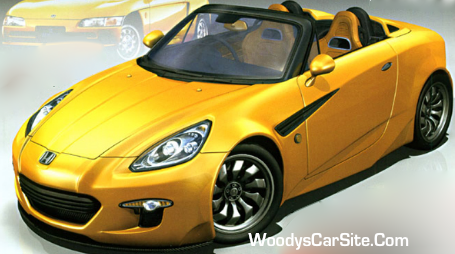
Beat it, just Beat it! Honda is looking to revive its adorable, legendary (adoregendary?) kei-class convertible, the Lilliputian Beat, this time with motorcycle technology.

The last Beat was built from 1991 to 1996 and featured a 650cc engine in the middle, three cylinders, 63 horsepower, rear-wheel drive, and a name that endlessly amuses Westerners. The next Beat, however, will presumably be bigger than that. It will also feature a dual-clutch transmission—for the first time in a Honda—borrowed from the “Shamu” VFR1200F, and attached to a 1.3- or 1.5-liter VTEC four-cylinder.

Rumors have it that the car would resemble the OSM concept shown above and also share a chassis on the CR-Z, which might diminish some of the Beat’s original tiny cuteness. As long as it’s not saddled as a hybrid, the next Beat should still be fun. Gotta Beat ‘em while you can, Honda.

Source;
http://www.autoguide.com/auto-news/2011/06/honda-beat-successor-rumored-with-dual-clutch-transmission.html

Monday, June 20, 2011

2012 Honda Civic Si Coupe - Road Test

Now Playing: Upsized and downrevved for the enthusiast of tomorrow.
BY JOHN PHILLIPS, PHOTOGRAPHY BY ROY RITCHIE May 2011

For the past six years, we’ve felt a little like Estragon and Vladimir in Waiting for Godot. So many hours have been lost debating whether the previous-gen Honda Civic Si produced enough power to hold its head above water in the pocket-rocket pond. Eventually, this existential controversy morphed into a kind of recreation, with Si devotees screeching fiery epithets from the bleachers. Well, finally, Generation Nine is upon us. “We’re saved!” shouted Beckett’s protagonists whenever they suspected Godot might momentarily appear.

Here’s a sad fact: Godot never showed. And whether the Si is “saved” likewise remains unclear.

Let us review recent history.

Our first encounter with the previous Si came late in calendar year 2005, when we pitted it against a Volkswagen GTI. The Honda lost. In 2009, we inserted an Si into a seven-car comparo, where it finished fifth, gasping and sweating. We weren’t surprised. The Si’s engine—2.0 liters, 197 horsepower, 139 pound-feet of torque—relegated it to least-powerful status in the whole segment. It certainly didn’t possess the grits to fend off, say, a 263-hp Mazdaspeed 3 Grand Touring or a 265-hp Subaru Impreza WRX. What’s more, accessing the Si’s horses has always required the spinning of the crank and cams to a fine fare-thee-well. The VTEC didn’t swap cam profiles until 6000 rpm, and it was thereafter vital to rely on every single rev right up to the colossal eight-grand cutoff.

Of course, Si purists—and trust us, they are legion—smugly insisted that the little howler-monkey engine comprised much of the car’s charm. Yet in the same breath, they’d also confess the coppery taste of  humiliation whenever a WRX achieved 60 mph 2.0 seconds in front of them, fast becoming a gnat on the horizon.

Now comes Honda’s solution for the ninth-gen Si, a solution both simple and a little surprising, given the rumors of a turbo. Out goes the 2.0-liter engine, in comes the naturally aspirated 2.4-liter unit that sees simultaneous duty in the Acura TSX. The result is an unnoticeable 4-hp gain, but torque is up 22 percent—peaking at 4400 rpm instead of 6100 rpm—and that’s a difference you can feel. While they were at it, the engineers paired the engine to the TSX’s delightful six-speed transaxle. But is that enough?

Well, sort of. At the track, the Si nailed 60 mph in 6.3 seconds versus the previous 6.7, and it proved a half-second quicker in our 5-to-60-mph rolling start. Turn off  the traction control, and you can now shred rubber for 15 feet, followed by a Rottweiler bark as you bang into second. An improvement, for sure, but it’s still shy of the accelerative thrust of five turbocharged competitors, including the Speed 3, the WRX, and even the GTI, which has a similarly meager 200 horses but can nonetheless summon 60 mph in 6.1 seconds.

On the other hand, the larger engine ushers in welcome perks. The mechanical thrash of the previous powerplant, for instance, is now largely MIA, and gear noise is likewise reduced, with all three of our sound-level tests confirming the fact. (Still, road-borne noise and tread roar remain issues that Honda must address.) Equally important, the number of shifts required for ’round-town cruising seems subjectively halved. In traffic, the Si is perfectly content relying on first, third, and fifth. And by eschewing a turbo, the Si’s mileage—now up to an observed 26 mpg—is best described as a charming achievement.

Yes, yes, 900 top-end revs have been lost. But the car now pulls with at least vague enthusiasm just after step-off. In fact, our only serious beef with the new engine is its considerable overrun when the throttle is suddenly dropped. Among other things, that makes for very little initial engine braking, and the revs sometimes take a couple of seconds to return to idle. Most drivers won’t complain, but it’s a behavior that lends the drivetrain a titch of laziness that has historically been anathema to Honda-think.

As with the previous-gen Si, this is among the most-neutral-handling front-drivers on the planet. Around our 15-mile public-road loop in southern Ohio, we could provoke only the most minor of nibbling understeer—and that was at speeds approaching Fear Factor Nine—with the rear tires faithfully following whatever paths had been established by the fronts. No rotation, no drifts, no drama. Body motions were exquisitely controlled, with the ride revealing the stiff springs and dampers only over high-frequency imperfections, primarily expansion joints and broken pavement.

At around-town speeds, the Si’s steering tends to feel artificial, as if it were the outcome of some sort of electrical/mechanical calculus that never precisely balanced. At least it’s light. As speed rises, fortunately, it firms up nicely and also becomes livelier. There’s no bump steer, no nervousness, and interstate tracking is peerless. The brakes are fade-free, and the pedal is firm and informative.

Moreover, the light, fluid shifter—as good as any that Honda has ever produced—allows the driver to summon alternate rev ranges with the flick of two fingers, abetted by a new lightweight clutch with simply seamless takeup. Faced with slow hairpins, the limited-slip differential carefully apportions power so that the inside front wheel never scrabbles. The thinly cushioned seats hold you firmly in place, and the dead pedal is perfectly sited. With lateral grip rising from 0.87 g to 0.90 g, the Si just dances and sings in the hills. This 2864-pound coupe is perfectly balanced, agile, poised, ever willing, a car that is easy to drive. Real fast comes real quickly.

The only obvious failure here is the unimproved interior. There are crass plastic trim bits on the steering wheel and around the HVAC controls. The Civic’s trademark minivan-sized windshield leans over a mini­van-sized dash, a vast plain of cut-lines, textures, and colors. The bunk-bed layout for the IP is okay, but the garish LCD gauges are right out of a RadioShack in Akron. The mouse-fur headliner suffers from the mange, and there’s a lumpy, wrinkled collar of felt that surrounds the steering column, shouting to one and all, “Yessir, that’s right, I actually am the cheapest bit of flotsam in the universe!” Note to Honda: Check out the Ford Focus’s interior.

The new Si—manual six-speed only—comes in both sedan and coupe forms. The coupe starts at $22,955, the sedan opens at $23,155, and both top out at $24,655. The only options are navigation, XM radio, and (exclusive to the coupe) summer tires—17-inch Michelin Pilot Exalto PE2s, as fitted on our test car. (Fun driving tip: Demand that your spouse call you “Pilot Exalto.”) If you’ve got a calculator handy, you’ll perhaps already know that a starter Si coupe is more than $1500 cheaper than either a GTI or a Speed 3.

This latest Si is more sophisticated than its forebear, although it has been somewhat cruelly left to play David to the turbocharged Goliaths. As of now, it offers a better ride, produces less noise, and is faster in both a straight line and through the most diabolical off-camber, double-apex turns that Ohio’s deranged civil engineers could conjure. It is surely less raw than its predecessor, a trait that many Si purists—including our own revered Tony Quiroga and Dan Pund—lament. Until they commit to a three-day, 800-mile road trip, two-thirds of which skates over frost-heaved interstates. No longer is the Si a one-trick pony. At speed it’s a serial killer, yet during commutes and city errands it’s a near-soothing mental-health counselor with practicality and a price that make it easy to justify.

And with that, as always, please feel free to express your unalloyed hatred.

Source;
http://www.caranddriver.com/reviews/car/11q2/2012_honda_civic_si_coupe-road_test

Honda rakes up 7,000 orders for Fit Shuttle, Fit Shuttle Hybrid

Earlier this week, Honda unveiled the new Fit Shuttle and Fit Shuttle Hybrid. The Honda Fit Shuttle and the Honda Fit Shuttle Hybrid are both offered in 2wD and 4WD with prices starting at at ¥1,610,000 for the Fit Shuttle and ¥1,810,000 for the Fit Shuttle Hybrid.
So far, Honda has raked up 7,000 orders for the new model with 90 percent of the pre-order sales coming in for the Honda Fit Shuttle Hybrid.

Will this encourage Honda to bring the Fit Shuttle lineup to the United States? It just might.

Refresher: The Honda Fit Shuttle is powered by a 1.5L i-VTEC gasoline unit allowing it to average an estimated fuel-economy of 44 mpg using Japan’s 10·15 testing mode. The Honda Fit Shuttle Hybrid is powered by a 1.3L i-VTEC engine mated to the company’s IMA (Integrated Motor Assist) hybrid system. It returns an estimated fuel-economy of 59 mpg.

Source;
http://www.egmcartech.com/2011/06/18/honda-rakes-up-7000-orders-for-fit-shuttle-fit-shuttle-hybrid/

Saturday, June 18, 2011

Don't Call it a Comeback....Honda Beat

Well, where there's usually this much smoke, there's fire....
Successor to tiny Nineties’ drop-top is on way


By Peter Lyon
10th June 2011

The Beat goes on, Auto Express can reveal. Sources in Japan say that Honda will combine the best of its car and motorcycle technologies to create a front-wheel-drive, two-seater sports coupé successor to the Nineties Beat.


The original was a 3.3-metre-long drop-top, produced between 1991 and 1996, that had a 660cc engine to take advantage of Japanese tax breaks. The reborn Beat coupé will be based on the platform of the petrol-electric CR-Z two-door, but employ a smaller body with shorter overhangs, and is likely to take cues from Honda’s OSM concept car.


It is rumoured to incorporate one of the firm’s next-generation petrol engines: either the 1.3 or 1.5-litre advanced VTEC, due to appear in the company’s production cars from next year. Our spies tell us that a hybrid is not being considered for the coupé, although stop-start will feature.


The engine bosses eventually choose will be hooked up to the company’s first-ever dual-clutch transmission for cars. This set-up is borrowed and adapted from Honda’s VFR1200F motorcycle.


Targeting coupés such as the next Mazda MX-5 and recently launched Renault Wind, the newcomer is due in dealers in late 2013. It’s expected to cost less than £20,000, and will be sold in the US as well as Europe.

Honda offers free parking at three malls to mark Father's Day

Here's a fun gimmick today related to Father's Day tomorrow.

Honda is putting teams of blue-uniformed valet parkers at three Southern California shopping malls today to try to create goodwill with potential car buyers. They say they will park any car -- not just Hondas.

Honda is providing free valet parking to all shoppers looking for last-minute Father's Day gifts at The Westfield Shopping Centers in Century City, Santa Anita, and Topanga.

Shoppers will also receive complimentary chapstick and window decals. Can't make it to the mall on Saturday? No worries, you can try to figure out where the crew will show up again on Facebook and Twitter.

In the past, the "guys in blue" pumped complimentary gas and offering umbrella escorts on rainy days.

The idea was created to combat a negative opinion of car dealers.

--Olivia Ouyang/Drive On

Source;
http://content.usatoday.com/communities/driveon/post/2011/06/honda-offers-free-parking-at-three-malls-to-mark-fathers-day/1

Friday, June 17, 2011

Honda Owner Nears One Million Miles

The average American driver racks up 13,476 miles per year on their odometer. That makes “Million-Mile” Joe, of Norway, Maine, well above average; Joe has accumulated nearly one million miles on his 1990 Honda Accord over the last fifteen years. That works out to be nearly 4,700 miles of driving per month, meaning that Joe drives as much in a season as the average American drives in a year.

A former automotive service technician turned insurance claims adjuster, Joe is meticulous about his car's maintenance, and keeps detailed records of all services performed. He’s got notebooks full of data, and Honda reports that he’s taken nearly 700 pictures of his odometer to document the mileage. If nothing changes, Joe is on schedule to cross the one-million-mile mark this September, and Honda will be documenting his progress on their Facebook page.

Joe bought his Accord as a six-year-old used car in 1996 with 74,000 miles on it. His obsession with keeping records didn’t start until he crossed the 300,000 mile mark, but it’s safe to assume that Joe followed the car’s maintenance schedule religiously even if he didn’t document it. As remarkable as Joe’s achievement is, it really highlights the fact that manufacturers publish recommended maintenance schedules for a reason; stick to them, and you may have a million mile car in your own garage.

Source;
http://news.discovery.com/autos/honda-owner-nears-one-million-miles-110617.html

2012 Honda FIT Shuttle Late Honda car debut turns into hot event

Not for us in North America.... yet....
Honda headquarters is sweltering, executives are without ties and reporters are fanning themselves in a scene illustrative of the nation's struggle to conserve electricity since March 11, when the massive earthquake and tsunami sent the Fukushima No. 1 nuclear plant into meltdown.


The scene unfolded as Honda Motor Co. launched the Fit Shuttle station wagon, including hybrid versions, for the domestic market Thursday — three months later than planned — another sign of the disaster's widespread impact.

The quake and tsunami destroyed Honda's parts suppliers, dealers and design facility in the Tohoku region.

Still, President Takanobu Ito was relieved the company had come this far.

"It was a real tough three months for us," he told reporters, wearing a casual beige jacket and no tie instead of his usual dark suits.

Cool Biz, the annual practice of allowing less formal attire to be worn in the office during the summer, is finally being embraced in a big way in the name of saving power. Now dubbed Super Cool Biz, some employees are even being encouraged to wear Aloha shirts and shorts.

Although no Honda executives were seen in shorts and their shirts were relatively staid, the nuclear crisis hung like a cloud over the event.

Tokyo-based Honda's invitation to the product launch — one of the first since March 11 — had warned that thermostats will be set at 28 degrees and that executives would be dressed in Cool Biz attire.

In addition to the Fukushima No. 1 crisis, which is expected to take years to resolve, another power plant was shut down months later over safety fears, causing the government to pressure companies and consumers to cut back on power use.

Automakers, a pillar of the economy, are under great pressure to cut power use 15 percent.
Autoworkers are producing cars on weekends and will instead take Thursdays and Fridays off for the next three months starting in July to reduce the load on power companies and avoid blackouts during peak demand periods.

Honda has said vehicle production in Japan will return to predisaster levels by the end of this month, and global production in August or September.

All orders for the Fit Shuttle will be delivered in two months' time, said Sho Minekawa, the executive in charge of Japan sales. There are no plans to offer the model overseas so far.

"We are finally able to introduce this product," he said. "We apologize to all those who have been waiting."

The Fit Shuttle, which comes as a hybrid (starting at ¥1.81 million) and with a gasoline engine (starting at ¥1.61 million), delivers the same mileage as the smaller Fit hatchback, according to Honda.

The hybrid version delivers 30 km per liter, or about 70 mpg, under Japanese test conditions, it said.

Honda is expecting its profit for the fiscal year through next March to plunge 63.5 percent to ¥195 billion from the previous year because of parts shortages and other disaster woes.

The maker of the Civic sedan and Odyssey minivan was battered by the cost of fixing damaged property and equipment, higher raw material costs, the strong yen and research expenses related to future products, such as environmental technology. Honda's global vehicle sales for the current fiscal year are projected to drop 6 percent on year to 3.3 million vehicles.

Honda to hire 1,000 temps
Kyodo
Honda Motor Co. will hire about 1,000 term employees at domestic plants, including in Saitama and Mie prefectures, during the second half of fiscal 2011 to cope with increased production expected from October to March, company sources said Thursday.

Honda is taking the measure because production is recovering from the March 11 catastrophe more quickly than anticipated and is expected to return to near normal by late June, they said.

The automaker will therefore withdraw its earlier plan set in April to gradually reduce the approximately 600 term employees at the plant in Saitama to zero by the end of September.

Honda will renew contracts of term employees if they want to do so, even for those whose employment contracts have already expired, they said.

Source;
http://search.japantimes.co.jp/cgi-bin/nb20110617a1.html